ReduceDataBlock
产品支持情况
- Ascend 950PR/Ascend 950DT:支持
- Atlas A3 训练系列产品/Atlas A3 推理系列产品:支持
- Atlas A2 训练系列产品/Atlas A2 推理系列产品:支持
- Atlas 200I/500 A2 推理产品:支持
- Atlas 推理系列产品AI Core:支持
- Atlas 推理系列产品Vector Core:不支持
- Atlas 训练系列产品:支持
- Kirin X90:支持
- Kirin 9030:支持
功能说明
头文件路径为:"basic_api/kernel_operator_vec_reduce_intf.h"。
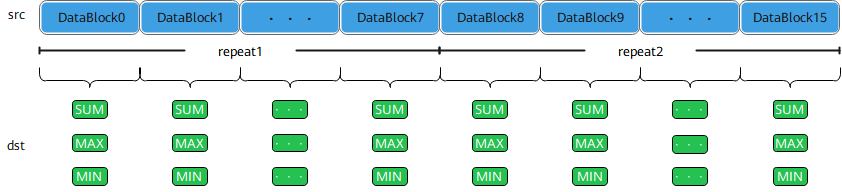
如图1所示,ReduceDataBlock接口对输入数据以DataBlock为单位进行归约操作,根据模板参数reduceType,对每个DataBlock内的数据求和/求最大值/求最小值。
ReduceDataBlock对输入数据进行多次迭代计算,每个迭代会取出8个DataBlock(每个DataBlock数据块内部地址连续,大小为32字节)进行计算,输出结果会连续写入目的地址。
图1 ReduceDataBlock归约示意图
函数原型
mask逐bit模式:C++template <ReduceType reduceType, typename T, typename U, bool isSetMask = true> __aicore__ inline void ReduceDataBlock(const LocalTensor<T>& dst, const LocalTensor<U>& src, const uint64_t mask[], const int32_t repeatTime, const int32_t dstRepStride, const int32_t srcBlkStride, const int32_t srcRepStride)mask连续模式:C++template <ReduceType reduceType, typename T, typename U, bool isSetMask = true> __aicore__ inline void ReduceDataBlock(const LocalTensor<T>& dst, const LocalTensor<U>& src, const int32_t mask, const int32_t repeatTime, const int32_t dstRepStride, const int32_t srcBlkStride, const int32_t srcRepStride)
参数说明
表1 模板参数说明
| 参数名 | 描述 |
|---|---|
| reduceType | 归约操作类型。 类型为 ReduceType枚举类型,支持:• ReduceType::SUM:求和;• ReduceType::MAX:求最大值;• ReduceType::MIN:求最小值。 |
| T | 目的操作数数据类型。 |
| U | 源操作数数据类型。 |
| isSetMask | 是否在接口内部设置mask。 • true,表示在接口内部设置mask。 • false,表示在接口外部设置mask,开发者需要使用SetVectorMask接口设置mask值。这种模式下,接口入参中的mask值设置为占位符 MASK_PLACEHOLDER,用于占位,无实际含义。 |
表2 参数说明
| 参数名称 | 输入/输出 | 含义 |
|---|---|---|
| dst | 输出 | 目的操作数。 类型为LocalTensor,支持的TPosition为VECIN、VECCALC、VECOUT。 |
| src | 输入 | 源操作数。 类型为LocalTensor,支持的TPosition为VECIN、VECCALC、VECOUT。 |
| mask[]/mask | 输入 | mask用于控制每次迭代内参与计算的源操作数。详细设置参考掩码概述。 |
| repeatTime | 输入 | 迭代次数。取值范围为[0, 255]。 |
| dstRepStride | 输入 | 目的操作数相邻迭代间的地址步长。 以一个 repeatTime归约后的长度为单位,在half数据类型时,单位为16字节;在float数据类型时,单位为32字节。取值范围为[0, 注意:Atlas 训练系列产品不支持配置0。 |
| srcBlkStride | 输入 | 源操作数单次迭代内DataBlock间的地址步长,单位为32字节。取值范围为[0, |
| srcRepStride | 输入 | 源操作数相邻迭代间的地址步长,即源操作数每次迭代跳过的DataBlock数目。取值范围为[0, |
注:以上高维切分相关参数mask,repeatTime,dstRepStride,srcBlkStride,srcRepStride请参考高维切分中的介绍。
数据类型
支持的数据类型如下:
- Ascend 950PR/Ascend 950DT,支持half、float。
- Atlas A3 训练系列产品/Atlas A3 推理系列产品,支持half、float。
- Atlas A2 训练系列产品/Atlas A2 推理系列产品,支持half、float。
- Atlas 200I/500 A2 推理产品,支持half、float。
- Atlas 推理系列产品AI Core,支持half、float。
- Atlas 训练系列产品,支持half。
- Kirin X90,支持half、float。
- Kirin 9030,支持half、float。
目的操作数与源操作数的数据类型需要保持一致。
返回值说明
无
约束说明
- 源操作数的对齐约束请参见通用地址对齐约束,起始地址需要32字节对齐;目的操作数起始地址的对齐约束与操作数数据类型有关,在
half数据类型时需要保证16字节对齐,在float数据类型时需要保证32字节对齐。 - 操作数地址重叠约束请参考通用地址重叠约束。
dstRepStride、srcBlkStride、srcRepStride取值范围为[0,],需要结合UB的实际大小避免出现越界。
当参数mask或repeatTime取值为0时,该接口的行为如下:
- 针对如下型号,当参数mask或repeatTime取值为0时,不会执行计算操作,不会对目的操作数进行写入,该接口将被视为NOP(空操作)。
- Atlas A3 训练系列产品/Atlas A3 推理系列产品
- Atlas A2 训练系列产品/Atlas A2 推理系列产品
- 针对Ascend 950PR/Ascend 950DT,该接口通过VF调用Reg矢量计算API实现兼容,当参数count或repeatTime取值为0时,不保证该接口被视为NOP(空操作)。
- 针对如下型号,当参数mask或repeatTime取值为0时,不会执行计算操作,不会对目的操作数进行写入,该接口将被视为NOP(空操作)。
- 对UB空间的占用说明。针对Ascend 950PR/Ascend 950DT:
- tensor高维切分计算占用8KB Unified Buffer。
- tensor前n个数据连续计算不涉及8KB Unified Buffer的占用。
- 针对如下型号,若配置
mask[]/mask参数后,存在某个DataBlock里的任何一个元素都不参与计算,不会有值写入对应目的操作数,保留目的操作数原有数据。- Atlas A3 训练系列产品/Atlas A3 推理系列产品
- Atlas A2 训练系列产品/Atlas A2 推理系列产品
- 针对Atlas 200I/500 A2 推理产品,若配置
mask[]/mask参数后,存在某个DataBlock里的任何一个元素都不参与计算,则会以默认值填充对应目的操作数,默认值与reduceType和数据类型有关:reduceType == ReduceType::SUM时填充0;reduceType == ReduceType::MAX,操作数数据类型为float时填充-inf,操作数数据类型为half时填充-65504;reduceType == ReduceType::MIN,操作数数据类型为float时填充inf,操作数数据类型为half时填充65504。- 比如
float场景下,当reduceType == ReduceType::MAX,mask=32,即只计算前4个DataBlock,则后四个DataBlock内的最大值会返回-inf。
- 针对Ascend 950PR/Ascend 950DT,若配置
mask[]/mask参数后,存在某个DataBlock里的任何一个元素都不参与计算,则会以默认值填充对应目的操作数,默认值与reduceType和数据类型有关:reduceType == ReduceType::SUM时填充0;reduceType == ReduceType::MAX时填充-inf;reduceType == ReduceType::MIN时填充inf。- 比如
float场景下,当reduceType == ReduceType::MAX,mask=32,即只计算前4个DataBlock,则后四个DataBlock内的最大值会返回-inf。
float数据类型只支持寄存器非饱和模式,half数据类型默认是寄存器非饱和模式。寄存器的非饱和/饱和模式具体配置方式参考SetCtrlSpr(ISASI).md。下图说明
reduceType取ReduceType::SUM时,在饱和模式下half数据类型的计算过程。源操作数为,首先 溢出,结果为 ,然后计算 ,最后计算 。 图2
ReduceDataBlock<ReduceType::SUM>饱和模式数值溢出情况处理说明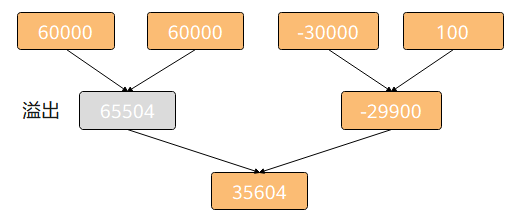
关键特性说明
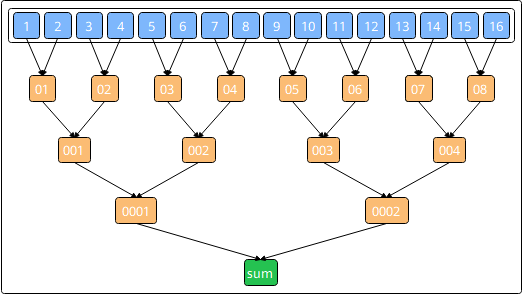
接口以二叉树的形式计算每个DataBlock内的结果。
以half类型的数据求和为例,在每个DataBlock内有16个数,通过二叉树的方式,两两相加,计算过程如下图所示:
- data1和data2相加得到data01,data3和data4相加得到data02,...,data13和data14相加得到data07,data15和data16相加得到data08;
- data01和data02相加得到data001,data03和data04相加得到data002,...,data07和data08相加得到data004;
- 以此类推,得到目的操作数为1个
half类型的数据sum。
图3 ReduceDataBlock<ReduceType::SUM>求和示意图
调用示例
本样例中只展示Compute流程中的部分代码。更多样例可参考ReduceDataBlock系列归约指令样例。
ReduceDataBlock<ReduceType::MAX>-tensor高维切分计算样例-mask连续模式:C++// 设定mask为最多的128个全部元素参与计算 int32_t mask = 256/sizeof(half); // 每个repeat128个元素,一共128个元素。 int repeat = 1; // dstLocal: 目的操作数tensor // srcLocal: 源操作数tensor // srcBlkStride = 1,在一个repeat中,block间没有空隙。 // dstRepStride = 1,srcRepStride = 8,repeat间没有空隙。 AscendC::ReduceDataBlock<AscendC::ReduceType::MAX, half>(dstLocal, srcLocal, mask, repeat, 1, 1, 8);结果示例如下:
输入数据src_gm:
[1, 1, 1, 1, 1, 1, 1, 1,
 1, 1, 2, 1, 1, 1, 1, 1,
 1, 1, 1, 1, 1, 1, 1, 1,
 1, 1, 1, 1, 1, 3, 1, 1,
 ...
 1, 1, 1, 4, 1, 1, 1, 1,
 1, 1, 1, 1, 1, 1, 1, 1,
]
输出数据dst_gm:[2, 3, ..., 4]
ReduceDataBlock<ReduceType::MAX>-tensor高维切分计算样例-mask逐bit模式:C++// 设定mask为最多的128个全部元素参与计算 uint64_t mask[2] = { UINT64_MAX, UINT64_MAX }; // 每个repeat128个元素,一共128个元素。 int repeat = 1; // dstLocal: 目的操作数tensor // srcLocal: 源操作数tensor // srcBlkStride = 1,在一个repeat中,block间没有空隙。 // dstRepStride = 1,srcRepStride = 8,repeat间没有空隙。 AscendC::ReduceDataBlock<AscendC::ReduceType::MAX, half>(dstLocal, srcLocal, mask, repeat, 1, 1, 8);结果示例如下:
输入数据src_gm:
[1, 1, 1, 1, 1, 1, 1, 1,
 1, 1, 2, 1, 1, 1, 1, 1,
 1, 1, 1, 1, 1, 1, 1, 1,
 1, 1, 1, 1, 1, 3, 1, 1,
 ...
 1, 1, 1, 4, 1, 1, 1, 1,
 1, 1, 1, 1, 1, 1, 1, 1,
]
输出数据dst_gm:[2, 3, ..., 4]
ReduceDataBlock<ReduceType::MIN>-tensor高维切分计算样例-mask逐bit模式:C++// 设定mask为最多的128个全部元素参与计算 uint64_t mask[2] = { UINT64_MAX, UINT64_MAX }; // 每个repeat128个元素,一共128个元素。 int repeat = 1; // dstLocal: 目的操作数tensor // srcLocal: 源操作数tensor // srcBlkStride = 1,在一个repeat中,block间没有空隙。 // dstRepStride = 1,srcRepStride = 8,repeat间没有空隙。 AscendC::ReduceDataBlock<AscendC::ReduceType::MIN, half>(dstLocal, srcLocal, mask, repeat, 1, 1, 8);结果示例如下:
输入数据src_gm:
[10, 10, 10, 10, 10, 10, 10, 10,
 10, 10, 10, 2, 10, 10, 10, 10,
 10, 10, 10, 10, 10, 10, 10, 10,
 10, 10, 10, 10, 10, -3, 10, 10,
 ...
 10, 10, 10, 10, 10, 10, 10, 10,
 10, 4, 10, 10, 10, 10, 10, 10,
]
输出数据dst_gm:[2, -3, ..., 4]
ReduceDataBlock<ReduceType::SUM>-tensor高维切分计算样例-mask逐bit模式:C++// 设定mask为最多的128个全部元素参与计算 uint64_t mask[2] = { UINT64_MAX, UINT64_MAX }; // 每个repeat128个元素,一共128个元素。 int repeat = 1; // dstLocal: 目的操作数tensor // srcLocal: 源操作数tensor // srcBlkStride = 1,在一个repeat中,block间没有空隙。 // dstRepStride = 1,srcRepStride = 8,repeat间没有空隙。 ReduceDataBlock<AscendC::ReduceType::SUM, half>(dstLocal, srcLocal, mask, repeat, 1, 1, 8);结果示例如下:
输入数据src_gm:
[1, 1, 1, 1, 1, 1, 1, 1,
 1, 1, 1, 1, 1, 1, 1, 1,
 2, 2, 2, 2, 2, 2, 2, 2,
 2, 2, 2, 2, 2, 2, 2, 2,
 ...
 3, 3, 3, 3, 3, 3, 3, 3,
 3, 3, 3, 3, 3, 3, 3, 3]
输出数据dst_gm:[16, 32, ..., 48]