核函数(Kernel)
核函数(Kernel)是在设备侧并行执行的C/C++函数。它由主机端代码调用,调用时被实例化为多份并行副本,分别调度到多个AI Core上运行(每个AI Core被抽象为一个Block)。这些Block利用AI Core的计算能力,协同完成某一算子的计算。
核函数(Kernel)的定义
定义核函数(Kernel)时需要遵循以下规则。
使用函数类型限定符和函数执行空间限定符
除了需要按照C/C++函数声明的方式定义核函数(Kernel)之外,还要为核函数(Kernel)加上额外的函数类型限定符。
必须使用__global__函数类型限定符来标识它是一个核函数(Kernel),可以被<<<...>>>调用。同时,需要根据算子实际执行的硬件单元,选择以下一种函数执行空间限定符,详情参考函数执行空间限定符:
- __aicore__:标识该核函数(Kernel)在设备端AI核上执行,不区分具体核类型(通常用于耦合模式)。
- __vector__:标识该核函数(Kernel)在设备端Vector核上执行,适用于仅包含Vector计算的算子。
- __cube__:标识该核函数(Kernel)在设备端Cube核上执行,适用于仅包含Cube计算的算子。
- __mix__:标识该核函数(Kernel)同时在Cube核和Vector核上执行,适用于包含Vector和Cube融合计算的算子。
使用变量类型限定符
指针入参变量需要增加变量类型限定符__gm__,表明该指针变量指向Global Memory上某处内存地址。
其他规则
- 规则:核函数(Kernel)必须具有void返回类型。
- 规则:核函数(Kernel)参数列表需遵循函数参数列表限制。
代码示例如下:
Text// Use the __global__ and __vector__ qualifiers to define kernel functions. __global__ __vector__ void add_kernel(__gm__ float* x, __gm__ float* y, __gm__ float* z) { ... } // Template-based definition of kernel functions is supported. An example of such a definition is provided below; it includes one type template parameter. template<typename T> __global__ __vector__ void add_kernel(__gm__ T* x, __gm__ T* y, __gm__ T* z) { ... }
核函数(Kernel)的调用
在Ascend C算子编程中,根据代码执行空间的不同,函数被严格划分为三类。它们之间的调用关系遵循如下规则:
- Host侧执行函数:运行于主机端(CPU)。除了支持标准C/C++语义下的同类函数互调外,其核心作用是作为计算任务的发起者,通过内核调用符<<<...>>>下发执行配置,跨界调用设备侧的核函数(Kernel)。
- 核函数(Kernel):运行于设备端(NPU),是Host侧任务下发的执行入口。核函数(Kernel)在组织并行计算逻辑时,可以向下调用其他的Device侧执行函数。
- Device侧执行函数:运行于设备端(NPU)的普通函数(除核函数(Kernel)外)。此类函数主要用于封装和复用底层计算逻辑,其调用权限被严格限制在设备侧内部,仅支持被核函数(Kernel)或同类的Device侧执行函数调用。
图1 核函数(Kernel)、host侧执行函数、device侧执行函数调用关系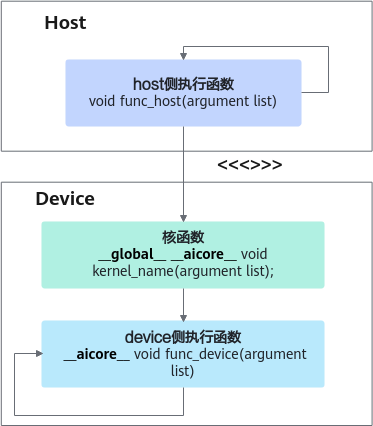
Host侧通过内核调用符<<<...>>>的语法形式调用核函数(Kernel),如下所示:
kernel_name<<<numBlocks, dynUBufSize, stream>>>(argument list);
<<<...>>>内的参数为核函数(Kernel)的执行配置,由3个参数决定,详细用法请参考核函数(Kernel)配置:
- numBlocks:规定了核函数(Kernel)将会在几个核上执行,对于不同的硬件架构和算子类型,numBlocks的设置规则有一些区别,详见核函数(Kernel)配置。每个执行该核函数(Kernel)的核会被分配一个逻辑ID,即block_idx,可以在核函数(Kernel)的实现中使用内置变量block_idx获取。需要注意的是,在使用
__mix__函数执行空间限定符的场景下,处在同一核上的Vector Core的block_idx取值相同,详细说明和示例请参考内置变量; - dynUBufSize:Dynamic Unified Buffer(UB) Size,是配置UB动态内存分配的空间的大小(仅限UB,不包括L1 Buffer等),单位为bytes,默认设置为0;
- stream:类型为aclrtStream,stream用于维护一些异步操作的执行顺序,确保按照应用程序中的代码调用顺序在device上执行,默认设置为nullptr。stream创建等管理接口请参考《Runtime运行时API》。
如下名为add_custom的核函数(Kernel),实现两个矢量的相加,调用示例如下:
// numBlocks is set to 8: Indicates that the add_kernel function is invoked on 8 cores. Each core will execute the kernel independently and in parallel.
// dynUBufSize is set to 0: Indicates that no dynamic memory space is allocated for the UB. The argument list for the kernel is x, y, z.
add_kernel<<<8, 0, stream>>>(x, y, z);

// The invocation format for a template kernel function is as follows:
// 1. Process Float32 vector addition.
add_kernel<float><<<8, 0, stream>>>(x_float, y_float, z_float);
// 2. Simply change the template parameter to int32_t to perform integer computation.
add_kernel<int32_t><<<8, 0, stream>>>(x_int, y_int, z_int);
核函数(Kernel)的调用是异步的,核函数(Kernel)的调用结束后,控制权立刻返回给主机端,可以调用以下aclrtSynchronizeStream函数来强制主机端程序等待所有核函数(Kernel)执行完毕。
aclError aclrtSynchronizeStream(aclrtStream stream);
aclrtSynchronizeStream的具体用法参考《Runtime运行时API》。
Blocks索引内置变量
在通过 <<<numBlocks, ...>>> 启动多核并行计算后,多个AI Core会同时执行同一份核函数(Kernel)代码。为了避免多个核重复处理同一块数据,我们需要在代码中对全局数据进行切分。
Ascend C提供了内置变量block_idx和block_num,帮助每个核精准定位自己需要处理的数据切片:
- block_num:获取当前核函数(Kernel)被分配的逻辑核总数(其值等于内核调用时配置的numBlocks)。
- block_idx:获取当前执行代码的逻辑核ID,取值范围为[0, block_num - 1]。
在Mix场景(使用__mix__函数执行空间限定符)下,Vector核(AIV)还需要通过sub_block_idx来确定在组合内的位置:
- sub_block_num:获取当前组合内Vector核的数量(即每个组合中AIV的个数)。
- sub_block_idx:获取当前Vector核在组合内的索引,取值范围为[0, sub_block_num - 1]。
在Mix场景中,AIV核的完整逻辑位置由block_idx和sub_block_idx共同确定:logic_idx = block_idx * sub_block_num + sub_block_idx。开发者应使用GetBlockIdx和GetSubBlockIdx API组合获取逻辑位置,而非直接使用内置变量(更多说明参见内置变量中的注意事项)。
以下示例展示了如何利用block_idx和block_num,将总长度为TOTAL_LENGTH的一维数据均匀分配给多个核进行处理:
// Assume the total amount of data to be processed is predefined in a macro.
constexpr uint32_t TOTAL_LENGTH = 8192;

__global__ __vector__ void add_kernel(__gm__ float* x, __gm__ float* y, __gm__ float* z)
{
    // 1. Get the logical ID of the current core and the total number of logical cores participating in the computation.
    uint32_t core_idx = block_idx;
    uint32_t core_num = block_num;

    // 2. Calculate the amount of data to be processed by the current core.
    // Assume TOTAL_LENGTH is perfectly divisible by core_num.
    uint32_t data_per_core = TOTAL_LENGTH / core_num;

    // 3. Calculate the data offset of the current core in Global Memory.
    uint32_t offset = core_idx * data_per_core;

    // 4. Offset the global pointers to obtain the addresses of the data slices belonging to the current core.
    __gm__ float* x_local = x + offset;
    __gm__ float* y_local = y + offset;
    __gm__ float* z_local = z + offset;

    // 5. Subsequent logic: Each core independently processes its own data slice (e.g., move to UB, vector addition, write back, etc.).
    // op.Init(x_local, y_local, z_local, data_per_core);
    // op.Process();
}
假设我们通过add_kernel<<<8, 0, stream>>>(x, y, z);启动了上述核函数(Kernel)(即block_num = 8)。
- 当block_idx = 0的核执行时,它的offset = 0,将负责处理全局数组中索引从0到1023的数据。
- 当block_idx = 1的核执行时,它的offset = 1024,将负责处理全局数组中索引从1024到2047的数据。
- 以此类推,8个核完全并行且互不干扰地完成了8192个数据的计算。通过这种分片机制,block_idx实现了软硬件之间的一一映射。