TBuf的使用
在大多数算子开发时,核函数(Kernel)计算过程需要使用临时内存来存储运算的中间结果,这些中间结果以临时变量表示,临时变量占用的内存可以使用TBuf数据结构来管理,具体介绍请参考TBuf。下文将以输入的数据类型为bfloat16_t、在单核上运行的Add算子为例,介绍TBuf的使用方式。本文中介绍的算子完整代码请参见使用临时内存的Add算子样例。
在Atlas A2 训练系列产品/Atlas 800I A2 推理产品上,Add接口不支持对数据类型bfloat16_t的源操作数进行求和计算。因此,需要先将算子输入的数据类型转换成Add接口支持的数据类型,再进行计算。为保证计算精度,调用Cast接口将输入bfloat16_t类型转换为float类型,再进行Add计算,并在计算结束后将float类型转换回bfloat16_t类型。
通过以上分析,得到Ascend C Add算子的设计规格如下:
算子类型(OpType):Add
算子输入输出:
表1 Add算子输入输出规格
name
shape
data type
format
x(输入)
(1, 2048)
bfloat16_t
ND
y(输入)
(1, 2048)
bfloat16_t
ND
z(输出)
(1, 2048)
bfloat16_t
ND
核函数(Kernel)名称:tmp_buffer_custom
使用的主要接口:
- DataCopy:数据搬移接口
- Cast:矢量精度转换接口
- Add:矢量基础算术接口
- EnQue、DeQue等接口:Queue队列管理接口
算子实现文件名称:tmp_buffer.asc
算子类实现
该样例的CopyIn,CopyOut任务与基础矢量算子相同,Compute任务的具体流程如下图所示。
图1 输入为bfloat16_t类型的Add计算流程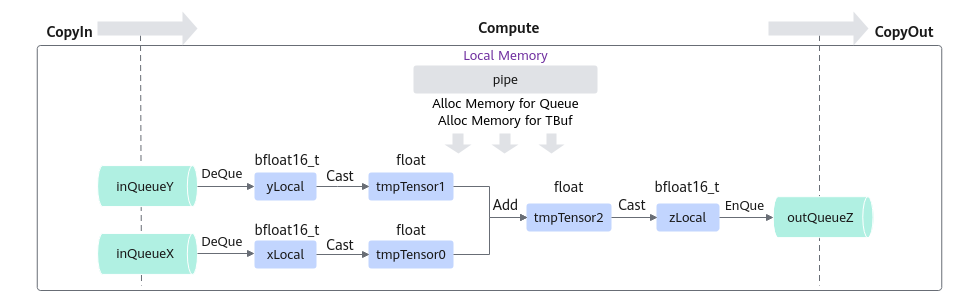
在计算过程中,表示Cast转换结果、Add计算结果的临时变量均需要使用临时内存存储。与基础矢量算子实现的KernelAdd算子类相比,本样例新增两个TBuf类型的成员变量tmpBuf0、tmpBuf1,用于管理计算过程中使用的临时内存,因此初始化阶段除原有步骤外,需要调用InitBuffer接口为TBuf变量分配内存,具体的初始化阶段代码如下:
// Init阶段
AscendC::GlobalTensor<bfloat16_t> xGm;
AscendC::GlobalTensor<bfloat16_t> yGm;
AscendC::GlobalTensor<bfloat16_t> zGm;
xGm.SetGlobalBuffer((__gm__ bfloat16_t*)x, totalLength);
yGm.SetGlobalBuffer((__gm__ bfloat16_t*)y, totalLength);
zGm.SetGlobalBuffer((__gm__ bfloat16_t*)z, totalLength);

AscendC::TQue<AscendC::TPosition::VECIN, 1> inQueueX;
AscendC::TQue<AscendC::TPosition::VECIN, 1> inQueueY;
AscendC::TQue<AscendC::TPosition::VECOUT, 1> outQueueZ;
pipe.InitBuffer(inQueueX, 1, totalLength * sizeof(bfloat16_t));
pipe.InitBuffer(inQueueY, 1, totalLength * sizeof(bfloat16_t));
pipe.InitBuffer(outQueueZ, 1, totalLength * sizeof(bfloat16_t));

// 初始化TBuf临时缓冲区,用于存储类型转换后的float数据
AscendC::TBuf<AscendC::TPosition::VECCALC> tmpBuf0;
AscendC::TBuf<AscendC::TPosition::VECCALC> tmpBuf1;
pipe.InitBuffer(tmpBuf0, totalLength * sizeof(float));
pipe.InitBuffer(tmpBuf1, totalLength * sizeof(float));
基于矢量编程范式,核函数(Kernel)需要实现3个基本任务:CopyIn,Compute,CopyOut。与基础矢量算子实现相同,核函数按顺序进行CopyIn,Compute,CopyOut。其中,CopyIn,CopyOut与基础矢量算子的CopyIn、基础矢量算子的CopyOut的实现没有差异,此处不过多赘述。Compute的实现步骤如下:
- 使用DeQue从Unified Buffer(UB,VECIN)的Queue中取出LocalTensor。
- 使用TBuf.Get从TBuf上获取全部长度的Tensor作为临时内存。
- 使用Cast接口将LocalTensor转换为float类型,并存入临时内存。
- 使用Add接口完成矢量计算,将计算结果存入临时内存。
- 使用Cast接口将临时内存中的计算结果转换为bfloat16_t类型。
- 使用EnQue将bfloat16_t类型的结果LocalTensor放入UB(VECOUT)的Queue中。
- 使用FreeTensor释放不再使用的LocalTensor。
// Compute阶段
xLocal = inQueueX.DeQue<bfloat16_t>();
yLocal = inQueueY.DeQue<bfloat16_t>();
AscendC::LocalTensor<bfloat16_t> zLocal = outQueueZ.AllocTensor<bfloat16_t>();
AscendC::LocalTensor<float> tmpTensor0 = tmpBuf0.Get<float>();
AscendC::LocalTensor<float> tmpTensor1 = tmpBuf1.Get<float>();
// 使用Cast接口将bfloat16_t转换为float类型,存入TBuf临时缓冲区
AscendC::Cast(tmpTensor0, xLocal, AscendC::RoundMode::CAST_NONE, totalLength);
AscendC::Cast(tmpTensor1, yLocal, AscendC::RoundMode::CAST_NONE, totalLength);
AscendC::Add(tmpTensor0, tmpTensor0, tmpTensor1, totalLength);
AscendC::Cast(zLocal, tmpTensor0, AscendC::RoundMode::CAST_RINT, totalLength);
outQueueZ.EnQue<bfloat16_t>(zLocal);
inQueueX.FreeTensor(xLocal);
inQueueY.FreeTensor(yLocal);