DoubleBuffer场景
因存在算子中多次搬入搬出数据的场景,为充分利用硬件资源,实现多流水并行,引入DoubleBuffer机制。DoubleBuffer是通过将输入数据分成大小相等的两块,充分利用AI Core的硬件资源,实现数据搬入、计算、数据搬出的并行执行方式。下面以“核间不均分,核内不均分”的样例为例,介绍算子中DoubleBuffer的实现。
图1 DoubleBuffer数据切分示意图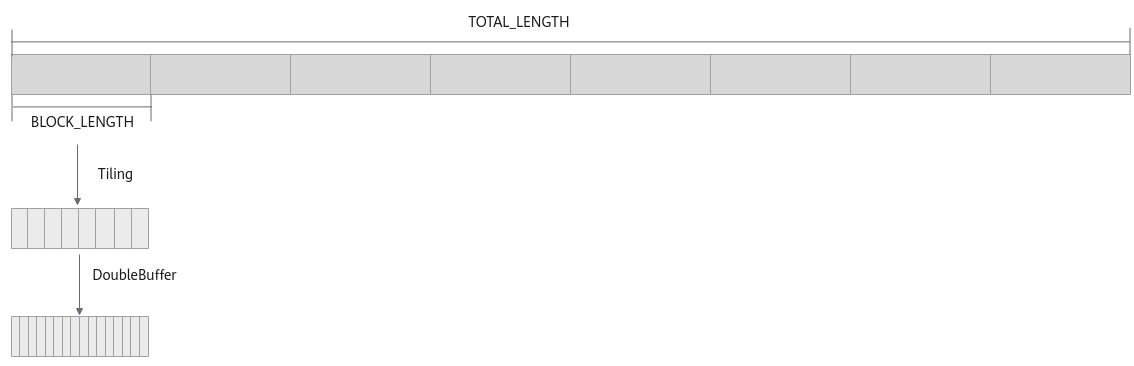
Tiling实现
开启DoubleBuffer后,每一个数据块会分成大小相等的两块,因此,若要开启DoubleBuffer,要求数据总量应该能够均分。为了简化处理,将可用的Unified Buffer(UB)空间以32字节为粒度,分成n块dataBlock,如果n不是偶数,则减1,这样就可以保证一套代码兼容开启或不开启DoubleBuffer功能。对应步骤如下:
判断数据总长度totalLength是否满足32字节对齐,如不满足,则计算totalLength向上32字节对齐后的长度totalLengthAligned。
Textconstexpr uint32_t BLOCK_SIZE = 32; // 为方便计算,这里根据数据类型定义变量alignNum作为对齐数 uint32_t alignNum = BLOCK_SIZE / dataTypeSize; // totalLength为数据总量 uint32_t totalLengthAligned = (totalLength % alignNum == 0)? totalLength : ((totalLength + alignNum - 1) / alignNum) * alignNum;根据totalLengthAligned,计算每个核的计算数据长度blockLength,分核策略可参照尾核切分。
计算其余Tiling参数。
对当前UB可用空间以32字节为粒度,进行切分,计算出数据块个数UB_BLOCK_NUM。根据是否开启DoubleBuffer计算出当前可用的最大数据块个数,记作MAX_AVAILABLE_UB_BLOCK_NUM。最后,以MAX_AVAILABLE_UB_BLOCK_NUM为粒度,对blockLength进行切分。为方便演示,如下代码直接给出UB_BLOCK_NUM,作为当前UB可用空间包含的block(32字节)数。
Textconstexpr uint32_t BUFFER_NUM = 2; constexpr uint32_t UB_BLOCK_NUM = 21; // UB最大可以使用的block数量 constexpr uint32_t MAX_AVAILABLE_UB_BLOCK_NUM = UB_BLOCK_NUM / BUFFER_NUM * BUFFER_NUM; tileNum = blockLength / (alignNum * MAX_AVAILABLE_UB_BLOCK_NUM); if (tileNum == 0) { // 单核需要计算的长度小于UB可用空间,按照仅有尾块处理 tileLength = 0; lastTileLength = (blockLength + alignNum - 1) / alignNum * alignNum; } else if ((blockLength / alignNum) % MAX_AVAILABLE_UB_BLOCK_NUM == 0) { // 单核的计算量能被当前可用UB空间均分,仅有主块,无尾块 tileLength = MAX_AVAILABLE_UB_BLOCK_NUM * alignNum; lastTileLength = 0; } else { // 同时有主块和尾块 tileLength = MAX_AVAILABLE_UB_BLOCK_NUM * alignNum; lastTileLength = blockLength - tileNum * tileLength; }
算子类实现
不开启DoubleBuffer时,只需要对每个核上最后一个分块的起始地址做处理;开启DoubleBuffer后,需要处理的数据块长度变成原来的一半,所以需要对最后两个数据块的起始地址做处理。
开启DoubleBuffer,参考InitBuffer接口函数原型,将num参数配置成2,即BUFFER_NUM。
this->initBufferLength = AscendC::Std::max(this->tileLength, this->lastTileLength);
pipe.InitBuffer(inQueueX, BUFFER_NUM, this->initBufferLength * sizeof(dataType));
pipe.InitBuffer(inQueueY, BUFFER_NUM, this->initBufferLength * sizeof(dataType));
pipe.InitBuffer(outQueueZ, BUFFER_NUM, this->initBufferLength * sizeof(dataType));
同时在计算核内每个数据块的长度时,考虑DoubleBuffer场景,需要将Buffer数量,即BUFFER_NUM=2带入计算。
this->tileLength = tiling.tileLength / BUFFER_NUM;
由于无法保证尾块满足DoubleBuffer的条件,因此不对尾块进行切分。
this->lastTileLength = tiling.lastTileLength;
Init函数实现代码如下:
__aicore__ inline void Init(__gm__ uint8_t* x, __gm__ uint8_t* y, __gm__ uint8_t* z, AddCustomTilingData tiling)
{
    if (tiling.isEvenCore) {
        this->blockLength = tiling.blockLength;
        this->tileNum = tiling.tileNum;
        this->tileLength = tiling.tileLength / BUFFER_NUM;
        this->lastTileLength = tiling.lastTileLength;

        xGm.SetGlobalBuffer((__gm__ dataType *)x + this->blockLength * AscendC::GetBlockIdx(), this->blockLength);
        yGm.SetGlobalBuffer((__gm__ dataType *)y + this->blockLength * AscendC::GetBlockIdx(), this->blockLength);
        zGm.SetGlobalBuffer((__gm__ dataType *)z + this->blockLength * AscendC::GetBlockIdx(), this->blockLength);
    } else {
        if (AscendC::GetBlockIdx() < tiling.formerNum) {
            this->tileNum = tiling.formerTileNum;
            this->tileLength = tiling.formerTileLength / BUFFER_NUM;
            this->lastTileLength = tiling.formerLastTileLength;

            xGm.SetGlobalBuffer((__gm__ dataType *)x + tiling.formerLength * AscendC::GetBlockIdx(), tiling.formerLength);
            yGm.SetGlobalBuffer((__gm__ dataType *)y + tiling.formerLength * AscendC::GetBlockIdx(), tiling.formerLength);
            zGm.SetGlobalBuffer((__gm__ dataType *)z + tiling.formerLength * AscendC::GetBlockIdx(), tiling.formerLength);
        } else {
            this->tileNum = tiling.tailTileNum;
            this->tileLength = tiling.tailTileLength / BUFFER_NUM;
            this->lastTileLength = tiling.tailLastTileLength;

            xGm.SetGlobalBuffer((__gm__ dataType *)x + tiling.formerLength * tiling.formerNum +
                tiling.tailLength * (AscendC::GetBlockIdx() - tiling.formerNum), tiling.tailLength);
            yGm.SetGlobalBuffer((__gm__ dataType *)y + tiling.formerLength * tiling.formerNum +
                tiling.tailLength * (AscendC::GetBlockIdx() - tiling.formerNum), tiling.tailLength);
            zGm.SetGlobalBuffer((__gm__ dataType *)z + tiling.formerLength * tiling.formerNum +
                tiling.tailLength * (AscendC::GetBlockIdx() - tiling.formerNum), tiling.tailLength);
        }
    }

    uint32_t initBufferLength = AscendC::Std::max(this->tileLength, this->lastTileLength);
    pipe.InitBuffer(inQueueX, BUFFER_NUM, initBufferLength * sizeof(dataType));
    pipe.InitBuffer(inQueueY, BUFFER_NUM, initBufferLength * sizeof(dataType));
    pipe.InitBuffer(outQueueZ, BUFFER_NUM, initBufferLength * sizeof(dataType));
}
由于开启DoubleBuffer后,切分后的主块数据块个数翻倍,在Process函数中,需要将BUFFER_NUM带入计算循环次数;尾块独立计算,不开启DoubleBuffer。后续主尾块在CopyIn、Compute、CopyOut阶段中的处理,与尾块均分相同。
__aicore__ inline void Process()
{
    // 主块进行DoubleBuffer计算,所以loopCount得乘以2
    uint32_t loopCount = this->tileNum * BUFFER_NUM;
    for (uint32_t i = 0; i < loopCount; i++) {
        // CopyIn:DataCopy(xLocal, xGm[i * this->tileLength], this->tileLength);
        //         DataCopy(yLocal, yGm[i * this->tileLength], this->tileLength);
        // Compute:Add(zLocal, xLocal, yLocal, this->tileLength);;
        // CopyOut:DataCopy(zGm[i * this->tileLength], zLocal, this->tileLength);;
    }
    // 尾块进行计算, 不做DoubleBuffer操作
    if (this->lastTileLength > 0U) {
        // CopyIn:DataCopy(xLocal, xGm[loopCount], this->lastTileLength);
        //         DataCopy(yLocal, yGm[loopCount], this->lastTileLength);
        // Compute:Add(zLocal, xLocal, yLocal, this->lastTileLength);;
        // CopyOut:DataCopy(zGm[loopCount], zLocal, this->lastTileLength);;
    }
}